
This me-made blouse and skirt set just makes me happy! I enjoy the touch of casual with an air of refinement that still keeps these two pieces classy no matter how they are paired. Burda Style’s “retro” patterns do well at helping me carry this unique sophistication every time I sew something from them. Happily, the style of the two pieces in this post are rooted in the sportswear of the post-WWII era, a fashion niche that I can never go wrong with! The early 1950s decade, in particular, had great easy-to-wear clothing that was practical yet polished and feminine with a flourish, as can be seen with the reprinted patterns I used. It is wonderful how fresh and timeless the styles of the past can be for today.

Burda’s retro releases are good at seamlessly melding styles of the past into today’s fashion, but I often only take a more authentically vintage interpretation. This time, my use of modern materials with an eco-conscious approach really helped me bring them into a new light. The blouse was made from poly scraps found second-hand and the skirt employed a modern blend remnant from my long-term stash. These may not have been my preferred choices of materials, as I recently become partial to more breathable natural fibers. However, these separates were a great way to use fabrics on hand that I previously had no idea what to do with. Together, I now have an outfit that I love, which doesn’t wrinkle, washes well, and pairs nicely with the rest of my wardrobe (when each is worn individually). I will keep whittling down at my stash of acquired fabrics by turning out pieces to enjoy for years to come. Compliments frequently come my way when wearing either of these items. Such happenstances are taken by me as further proof that these projects were meant to be sewn!

THE FACTS:
FABRICS: a pebbled finish polyester crepe for the blouse and a cotton and rayon blended “linen-look” material for the skirt
PATTERNS: Burda Style “Patch Pocket Wraparound Skirt” pattern #109B from February 2015 together with Burda Style “Retro Wrap Blouse”, originally from August of 1950, but re-released as pattern #134 in May 2014

NOTIONS NEEDED: lots of thread, one vintage metal zipper (which was to accommodate my changes to the blouse pattern), some bias tape, and scraps of interfacing
TIME TO COMPLETE: The blouse took me 10 hours in November 2020 while the skirt was sewn back in April 2015, in 6 hours.
THE INSIDES: cleanly bound in bias tape
TOTAL COST: The fabric for the blouse was only $1, all notions were second-hand acquired and already on-hand, while the skirt’s fabric is as good as free to me, being bought 15 or more years ago. The skirt only calls for two yards, and the top can be made with scraps that amount to a yard, so both items could be made on a very reasonable budget, even if I had paid full price for new fabrics! I count this as a $10 or less set, the way I made it work.
Because I like to choose sewing projects which will be some sort of challenge to my skills, the skirt and blouse both have unique construction methods behind their design lines. This gave them a surprising level of difficulty. The skirt’s complexity is hidden in some unassuming details, and the blouse has a flourish at the neckline which is not crafted as one might expect. Vintage garments are great at having surprising details like this, and this benefit is one of the many ways that the designs of the past are so endearing to many sewists.

I suspect that the skirt is not an original vintage design. Nevertheless, the silhouette, the details, and its wrapped closure method are all straight out of garments and sewing patterns which date from between 1940 to 1952. The blouse is supposed to be a reprint from a Burda Style magazine of August 1950 (as I found out through the blog “Doctor T Designs”) for a great pairing from within the time frame just mentioned. It seems to have kept most of its original construction details despite being modernized in its sizing for re-issue. I still prefer working with true vintage designs, yet, as a modern option, I love to tackle these vintage-inspired Burda Style patterns!

It was fun to “wrap” my head around the idea of the skirt. It is a tie-on design that utilizes a front box pleat that is divided into two separate folds. The one box pleat fold is top stitched down to the skirt and sewn into the waistband. Then, the one open box pleat has a vertical slit which extends down the inner (and therefore hidden) fold. This design helps the skirt to be both adjustable in fit as well as free of a zipper, button, hook, and snap. Super long ties keep the skirt closed, with one tie popping out from underneath through a little ‘window’ in right side of the waistband. The ties are so long, I can double wrap them around my waist to knot in the front, or leave them in a large bow in the back. Thus, as you can see, a soft but stable fabric is essential to this design. There is the need for structure to keep the straight-lined silhouette, while also being supple enough to work well for manipulating the waist ties.

The box pleat folds meet in varying degrees based upon my measurements for any given day. Do not expect consistent perfection in the fit of this skirt if you decide to try it for yourself…something I wholeheartedly recommend. Sometimes the front folds meet precisely together, other times the folds slightly overlap (when I am thinner), while other times there is a small gap between the box pleats. This is why choosing a size for this design is sort of tricky. An adjustable fit for a design like this is not going to show a consistent match across the box pleat. Bodies are changeable! Understanding this, and giving myself grace to accept my body as it is, helped me both understand and enjoy this amazing garment. If anyone else notices that something is off with such a small detail as the box pleat folds on my skirt, they are too close for comfort anyways.

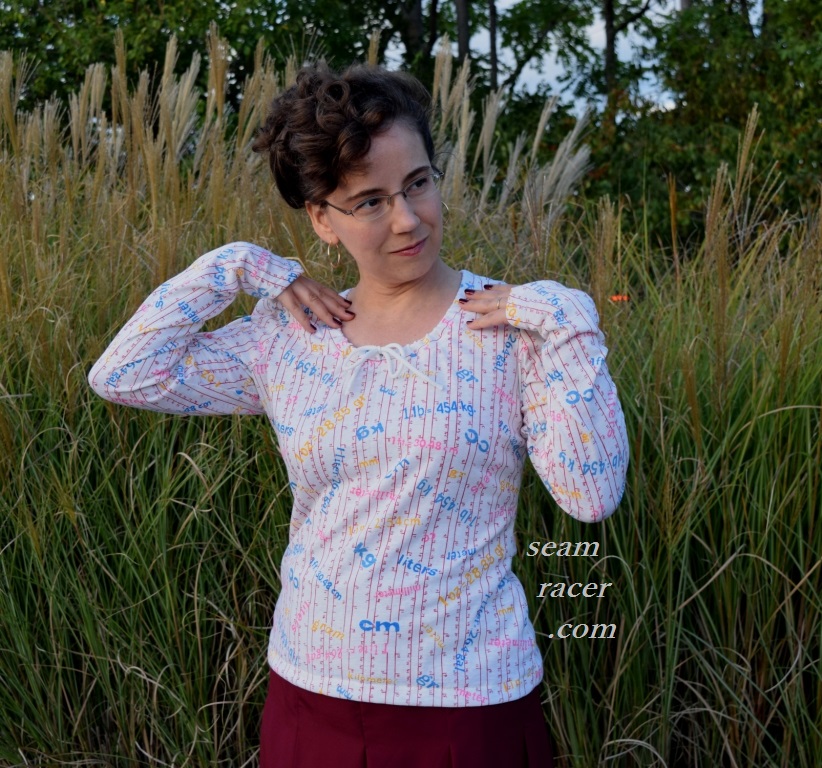
The blouse had a construction method which was much harder to comprehend. Once I dove into actually making it, the blouse suddenly made more sense. However, it wasn’t until I got to try it on that I fully realized how the design works. The front neckline flourish is not straightforward and it is up to the individual to tailor the look of the tie, so this adds to the confusion. The one side of the front has a tube, while the other side has a long tie. That tie gets folded over in half and the fold is pulled up (towards my chin) into a pouf, while the free end hangs down. This is the way the pattern, the model image, and my own pictures in this post all show the front closure being managed. Nevertheless, I found many other fun ways to play around with the front tie design, offering the ability to change up the front of this blouse for a fresh look every time it is worn. It’s no wonder I gravitate towards versatile and adjustable designs in my sewing adventures! It really makes for a wardrobe out-of-the-ordinary as well as clothes which work for my changing bodily needs and tastes.

I did adapt the design, though, to eliminate some of the adjustability to the fit since it struck me as mere extra fussiness to its closing system. There already is a tie front closure to the blouse. I felt that the waistline did not need to be wrapped closed, as well, leaving the entire center front seam open for confusion when dressing. Furthermore, I could only envision a bulky waistline going under my skirts and pants, making my torso uncomfortable. If I was using a chiffon, silk satin, light knit, or natural fiber crepe, than I might have kept the wrapped waistline. However, the poly crepe was too stiff for that detail. Besides, my clothes need to work for my every comfort or style preference, especially since I am the one sewing them! Even if such an aesthetic decision hadn’t been made, my change to the design was ultimately needed to accommodate my extreme lack of material from working with haphazardly shaped scraps.

The one-step fix I did to alter the wrapped waistline was to seam together the center front (below the tie) into a zipper. I chose a sturdy vintage metal zipper from my late Grandmother’s stash of notions so as to honor the 1950s origin to the pattern. The zipper is concealed completely under the fluffiness of the front neckline tie. An inch or so under the bottom of the tie is the only part of the blouse front that is connected together in my adaptation. Yet, since the zipper opens up, I can easily pop the blouse on without pulling the tie closure each time apart for a much appreciated ease of dressing.

Be aware that the blouse’s sizing did run small, and I easily could have sized up one whole number…or even two! Such a snug sizing would make this a good pattern for a knit fabric. However, the pattern instructions strangely did not directly specify whether to choose a woven or a knit. The instructions merely called for “fabrics with some body” which have two “good” sides. My poly crepe did fulfill these needs, but a little more forgiveness in the fit would have been appreciated. I am not used to having zero ease in a woven garment, yet the tie front and almost sleeveless design are the saving features that provide some flexibility to the blouse. The snug fit does keep my blouse in place, as I can see it twisting around on my body otherwise…so maybe the sizing is correct after all. Such a tight fit just makes my blouse seem more modern than vintage to me, for whatever that fact is worth.

This set, for as much as I love it now, was rife with indecision along the way to completion. The first was in regards to my choice of color. Unless I am working with a complex pattern that has design lines which need to shine, I am often afraid to choose solid colors for my sewing. Not only do I have a hard time choosing solid colors to commit to, but I also fear an unbroken tone will only let most of my chosen designs fall flat. Yet, in this case, I think the plain, soothing earth tones lends them to being useful yet also standout wardrobe items. Then, I was unsure whether or not the enormous pockets would overwhelm the skirt silhouette, and so they were the last thing I stitched down before calling it finished. Yet, how could I not fall for such a feature handy enough to hold a book, a wallet, or a drink?!? These are the gold standard example in pockets, second place to the ones on this vintage 1930s smock frock (posted here). The pockets are just about the size of the modern “fat quarter”. I can envision some fun contrast fabric for these awesome pockets on another version of this skirt. This “PatternReview.com” member (post here) decorated her pockets with embroidery!
Ready-to-wear rarely sacrifices so much extra fabric for pockets, but this is the kind of thing that women really want from their clothing, more often than not. Also, ready-to-wear rarely offers much variety when it comes to colors. I am very picky when it comes to what solid colors I like, especially for brown tones (since I already have brown hair and eyes). Using second-hand fabrics that have been around already lets me find greater individuality and cater to my personal preferences. Sewing my own wardrobe is really the only way I can wear clothing that helps me feel like my best self and comfortable in my own skin.

I’m glad to have pushed through my hesitancy and went along with the best decision I could make at the time. Often, all it takes for me to see how successful my sewing efforts were is to dress myself in my newly finished garment and accessorize the outfit as if I was ready to go out. Then, my mind can turn to relief. Yet, I also see how my doubts were a waste of mental energy. Sometimes, I have a limited predisposed ideal and find a surprise awaiting me at the time of finishing (as was done here). For other projects, a set ideal is perfectly achieved through my sewing, while others times I fall short of my goals. Nevertheless, I always make sure I end up happy with what I made, after it all. Every one of my sewing projects is such a rewarding experience in resourcefulness, self-confidence, and finding individual expression. For those of you that sew, what does the creative process mean to you personally? For those of you that are not “makers”, how do you curate a wardrobe that can more closely reflect your individuality? Do you enjoy garments that are both versatile and adaptive, like I do?





 seamracer.wordpress.com